
Es ist Klassismus, nicht Klassizismus: Anticlassist Killjoy Guide for beginners at the Udk and in the Theatre Field

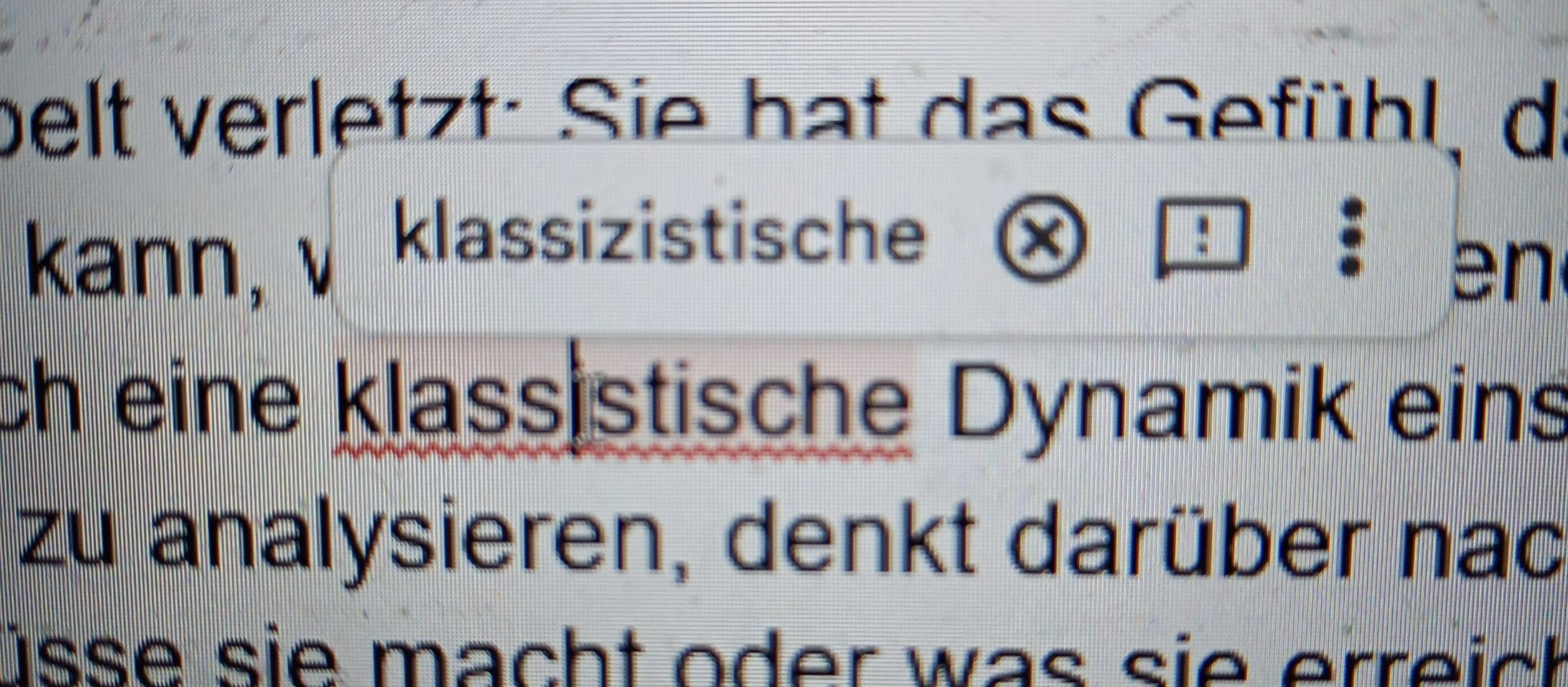
Nahaufnahme eines Textdokuments auf einem Computerbildschirm. Das Wort „klassistische“ wird von der Rechtschreibprüfung als fehlerhaft markiert und rot unterstrichen. Als korrekte Schreibweise wird „klassizistische“ vorgeschlagen.

Sorry, this entry is only available in Deutsch.

Nahaufnahme eines Textdokuments auf einem Computerbildschirm. Das Wort „klassistische“ wird von der Rechtschreibprüfung als fehlerhaft markiert und rot unterstrichen. Als korrekte Schreibweise wird „klassizistische“ vorgeschlagen.

Ich habe sehr oft den Fehler gesehen, dass man eine Liste von Diskriminierungsformen erstellt und dabei Klassizismus statt Klassismus schreibt, sogar für meine Word-Datei zu diesem Text ist das Wort ein Tippfehler. Man muss nicht viel recherchieren, um die Gründe dafür zu verstehen. Meines Erachtens wird das Wort nicht so oft benutzt. 

Klassismus: Diskriminierung oder Vorurteile gegenüber einer Person oder Personen aufgrund einer [vermuteten] Zugehörigkeit zu oder Herkunft aus einer bestimmten [niedrigeren] sozialen Klasse[1]

Kunsthochschulen sind ein Hotspot für Klassismus, doch es kann schwierig sein, bestimmte Situationen zu benennen, weil viele Codes über Jahre hinweg normalisiert worden sind und nicht als Diskriminierung adressiert werden können, ohne dass man als Killjoy[2] gilt. Ich schreibe diesen Artikel in der Tradition der Selbst-Ethnographie, ich habe Szenisches Schreiben abgeschlossen, und meine Erfahrungen sind stark im Literaturbereich und in den darstellenden Künsten verankert. Ich schreibe, um euch auch zu ermutigen, Killjoys zu werden und Klassismus an der UdK und im Theaterbereich besser zu erkennen und zu bekämpfen und meritokratische Diskurse zu hinterfragen. 

Ökonomische Zugänglichkeit, Erasure und Fetischisierung

Während meines Studiums musste ich viel mit Wut umgehen. Wut darüber, dass Menschen mir Sätze gesagt haben wie: „Wähl das Foto lieber nicht. Da siehst du wie eine Kindergärtnerin aus“, nachdem ich Fotos aus meinem Autor*innenportfolio gezeigt hatte. Kann man nicht beides sein? Und was wäre daran schlimm? Hatte meine Mutter keinen Stil, als sie als Kindergärtnerin gearbeitet hat? Doch. Oder Aussagen wie: „Oh, du bist ja so reich!“, nachdem ich einer Person mein Kontoauszug mit Bafög-Ersparnissen aus Versehen gezeigt hatte – einer Person, die nicht arbeiten musste und keine Miete selbst zahlen musste, weil die Eltern dafür gesorgt haben. Ich hatte das Privileg als EU-Mitglied, Bafög zu beziehen, allerdings musste ich als Person ohne deutsche Staatsbürgerschaft beweisen, dass ich während des Studiums mindestens 12 Stunden pro Woche gearbeitet habe. Ja, wenn man für das Leben arbeiten muss, muss man auch sparen, wenn es überhaupt möglich ist. Ich dachte, das wüssten alle. Aber vielleicht, wenn man nur Geld von den Eltern überwiesen bekommt, ist es nicht so. Wenn man nicht Angst hat, Bafög-Schulden zurückzahlen zu müssen. Manchmal sind Werte und Dynamiken, die ich als “selbstverständlich” wahrnehme, eigentlich klassenbedingt. Meine Wut hat sich inzwischen in Traurigkeit verwandelt, weil ich gemerkt habe, dass man sich über diese Themen kaum unterhält. Oft weiß man einfach nichts über die Lebensrealitäten anderer Menschen.

Sehr oft werden an der Uni (Kooperations-)Projekte angekündigt – spannende, gut gemeinte Projekte, für die man sich manchmal bewerben muss. Eine Bewerbung, in die viel Arbeit fließt, Arbeit, die am Ende möglicherweise umsonst ist. Die Zeit für diese Bewerbungen ist im Stundenplan jedoch nie mitgedacht. Das ist an sich schon problematisch, wird aber oft hingenommen, da die UdK Berlin ohnehin den Ruf hat, eine Universität zu sein, an der es extrem schwierig ist, etwas anderes neben dem Studium zu machen (z. B regulärer Lohnarbeit nachzugehen), an der sich Studierende zu 100 % der Kunst widmen können. Darüber hinaus ist das größte Problem meiner Meinung nach, dass viele Projekte keine klare ökonomische Zugänglichkeit haben. Wenn es um Reisen geht: Werden die Kosten erstattet? Wenn ja, wann? Müssen Rechnungen vorgestreckt werden? Wann weiß ich, ob ich Ferien beantragen muss, falls ich ortsgebunden bin?  Sehr oft kommen diese Informationen zu spät, als wären sie nur eine zusätzliche organisatorische Randnotiz und keine Form von Zugänglichkeit. Natürlich liegt das manchmal daran, dass Förderungen erst spät bestätigt werden. Die entscheidende Frage bleibt jedoch: Wer leidet darunter?

Wenn die ökonomische Zugänglichkeit von Projekten an der Universität oder von Ausschreibungen mit Kooperationspartner*innen nicht transparent ist, werden klassenbedingte Ausschlüsse produziert. Diese Problematiken werden jedoch nicht von der Mehrheit erlebt, und über Geld zu sprechen gilt schnell als unhöflicher Killjoy. Dadurch findet häufig Erasure statt, weil sich betroffene Menschen nicht trauen, etwas zu sagen. Wenn man dennoch etwas anspricht, gilt man entweder als unsympathisch und wird kleingeredet, oder man wird zum Teil fetischisiert. Während meiner Zeit an der UdK habe ich viel Armutscosplay und Saviourism[3]gesehen. Mit Fetischisierung meine ich, wenn eine bestimmte Person immer dann angeschaut oder angesprochen wird, wenn es um Geld geht. Wenn die Privatsphäre der Person zur Diversity-Erfahrung übersetzt wird. Die Zugänglichkeit eines Projekts sollte von der gesamten Gruppe mitgedacht werden, nicht nur von den Betroffenen. Zugänglichkeit muss Teil eines Projekts sein und nicht nur für Virtue Signaling[4] ausgenutzt werden. 

Geschmacksdiskurs und Habitus

Eine weitere Form, Klassismus zu erzeugen – ohne dass dies unbedingt beabsichtigt ist, denn mein Punkt hier ist Institutionskritik – besteht darin, elitäre Netzwerke zu reproduzieren. Jobs bekommt eine Person zum Beispiel, wenn sie zu bestimmten Premieren geht, die einen teuren Eintrittspreis verlangen oder wenn sie an bestimmten Veranstaltungen außerhalb von Berlin teilnimmt. Auch wenn diese Netzwerke sich nach außen als zugänglich präsentieren, gibt es darin einen Habitus[5], der weniger zugänglich ist. Und es braucht sowohl Geld als auch Zeit. Wie lange muss jemand mit Ferienwohnungen-Problemen empathisieren, um einen Job im Staatstheater zu bekommen? In solchen Momenten habe ich bemerkt, dass mir in Deutschland nicht nur Vitamin D fehlt, sondern auch Vitamin B. 

Als migrantische Person der ersten Generation klingt es zunächst gut, die „richtigen“ Menschen endlich durch Talent oder Tokenism[6] zu erreichen. Gleichzeitig fühlt sich das politisch schief an. Warum bin ich jetzt hier? Wegen meiner Kunst oder meiner Identität? Welche Privilegien haben mich hierher gebracht?  Warum fühle ich mich trotzdem fehl am Platz? 

Was sehr viele Aufstiegsbiographien im Kunstbereich verbindet, ist die Enttäuschung, wenn symbolische Macht sich nicht direkt in ökonomische Macht verwandelt. Die UdK ist mehr oder weniger demokratisch, wenn es um symbolische Macht geht. Ein UdK-Abschluss öffnet viele Türen, aber wie viele Türen können nachhaltig offen bleiben, wenn man nicht schon vorher ökonomische Sicherheit hatte? 

Nachdem ich ja nun meine aufstiegsbiografische Position geoutet habe, komme ich zum nächsten Punkt: Geschmack. Geschmack ist unter anderem klassenbedingt. Er funktioniert subtil. Aber wenn wir ökonomische Zugänglichkeiten im Kunst- und Theaterbereich transparent machen, werden wir zwangsläufig mit einem Geschmacksdiskurs konfrontiert. Hier ließe sich der häufige Rechtschreibfehler tatsächlich produktiv wenden: Klassizismus. Wer entscheidet was zum Klassiker wird?  Es gibt bestimmte ästhetische Setzungen – Mischungen aus Themen und Formen –, die bei einigen Klassen sehr gut ankommen und bei anderen kaum. Zum Beispiel ertrage ich kaum Texte in denen die Arbeiter*innen Klasse romantisiert wird oder mit der Armutsklasse gleichgesetzt wird und habe zudem manchmal das Gefühl, dass einige Texte “realitätsfern” in mir wirken, wobei sie realistisch sein sollten.  Welche Klasse ist für die Preiskultur zuständig? Welche Narrative gehen immer weiter? Habitus beinhaltet auch Geschmack. Natürlich gibt es Ausnahmen aber wenn man sich die Statistiken von Arbeiter*innenkindern anschaut, sieht man dass sie es z. B. nicht zu oft in den Kulturbereich schaffen. Geschmack ist natürlich nicht nur Klasse, aber wenn ein bestimmter Geschmack eine große Mehrheit in Machtpositionen hat, sollte man das im Studium zumindest thematisieren. Geschmacks-Diskursen waren aber komplett abwesend, nur Angst vor Aneignung war sehr oft im Raum.  

Dogmatische Identitätspolitik und Repräsentation

Was mir in Bezug auf Klassismus an der UdK Berlin besonders auffällt, ist, dass problematische, direkt klassistische Aussagen oft von Personen, die vorgeben sich intensiv mit dekolonialen und machtkritischen Diskursen auseinandergesetzt zu haben. Viele lernen Diskriminierungsformen ausschließlich theoretisch und verwenden bestimmte Paradigmen als starre Dogmen statt als Instrumente. Eine kleine Anekdote dazu:

Ich schreibe eine autofiktionale Szene über Erschöpfung und Klassenerfahrung an der Universität – ja, das ist momentan ein bisschen mein Fokus– und wir suchen ein Team für eine kleine Werkstattinszenierung. Abends bekomme ich einen Anruf und mir wird mitgeteilt, dass die Person, die die Rolle spielen könnte, keine Migrantin sei. Damit habe ich kein Problem und freue mich auf die Proben. Weniger freue ich mich darüber, dass ich gebeten werde, den Text zu kürzen (Kürzungen sind für Schriftsteller*innen immer schmerzhaft, egal ob im Text oder auf finanzieller Ebene in der Kulturpolitik). Ich stimme trotzdem zu und streiche die Teile über Sprachschwierigkeiten und das Thema Migration. Ich entscheide mich selbst dafür, um weniger Stress zu haben und zu verursachen. Übrig bleibt ein Text über Erschöpfung. Ich schlage vor, stärker die ökonomischen Bedingungen zu inszenieren, und höre folgende Antwort:
„Ja, aber wir können keine Unterdrückung zeigen, wir haben keine Schwarze Person auf der Bühne.“  Da der Monolog autofiktional ist, antworte ich spontan: „Ich bin auch nicht Schwarz aber ich erlebe die Unterdrückung!“ – „Ja, du!“. Für mich war die erste Antwort rassistisch, auch wenn sie aus der Idee heraus entstanden ist, keine Aneignung von Unterdrückung zu betreiben. Warum durfte nur ein schwarzer Körper Unterdrückung auf die Bühne bringen und warum könnte nicht ein schwarzer Körper einfach dort sein wenn race kein Thema ist?

Mir ist wichtig zu betonen, dass ich weiß bin. Ich erfahre keinen Rassismus, und ich halte es für zentral, die analytische Schärfe dieser Begriffe zu bewahren. Was im Text auf der Bühne beschrieben wurde, war eine Klassenerfahrung, die auch die weiße deutsche Arbeiterklasse widerspiegeln könnte. Im Raum existierte jedoch nur ein sehr binärer Schwarz-Weiß-Diskurs, der weit entfernt war von Klassenbewusstsein oder materialistischer Analyse.

Ich verstehe, dass sich die darstellenden Künste intensiv mit Repräsentation beschäftigen müssen. Dennoch ergibt es keinen Sinn, Identitätspolitik auf diese Weise zu verwenden. Ich war die migrantische Person im Raum, und deshalb konnte  niemand meine Geschichte adäquat spielen. Woher kommt diese Angst? Warum? Wer profitiert davon?

Es stimmt, dass Rassismus und Klassismus sehr oft zusammengehen und ein bisschen so wie ein toxisches Liebespaar funktionieren, aber sie existieren auch unabhängig voneinander. Es ist wichtig, Diskriminierungsformen intersektional zu denken, aber es ist auch wichtig, die Phänomene unabhängig voneinander betrachten zu können. Ich bin der Meinung, dass es nicht nur machbar, sondern auch notwendig und dringend ist. Nur mit den richtigen Instrumenten können wir hegemonische Diskurse hinterfragen, andere Perspektiven sichtbar machen und echte critical diversity fördern. Es gehört zur Antidiskriminierungsarbeit. Die UdK Berlin braucht mehr Killjoys und einen internen, kollektiven Abbau von diskriminierenden und ausschließenden Strukturen, die derzeit für Viele nicht einmal sichtbar sind. Das können und dürfen sich nicht allein die betroffenen Menschen leisten. Ich beende diesen Artikel mit einer letzten Anekdote, die eine Art Zusammenfassung ist. 

Einmal hatten wir einen Workshop, zu dem ich einen Text mitgebracht hatte, der erneut autofiktional war (ja, vielleicht muss ich damit irgendwann aufhören, um weniger Stress zu haben). Meine Erfahrungen mit dem Putzen als Au-pair mit Stauballergie hatte ich in eine Figur übersetzt, die als Reinigungskraft arbeitet. Eine bekannte Künstler*in, die den Workshop leitete, deutete immer wieder an, es handle sich dabei um eine Form von Klassenaneignung. Ich ignorierte diese Provokationen, bis die Person sagte: „Ich habe eine Freundin, die als Reinigungskraft arbeitet – was würde sie über deine Texte denken?“ Ich wollte mich nicht als Arbeiterklasse outen, ich wollte meine Biographie nicht rechtfertigen. Doch genau darum geht es: das Image der UdK: ein Ort für rich kids. Ein Ort, wo einige Menschen sich nicht einmal vorstellen können, dass Studierende gleichzeitig putzen und schreiben können, oder dass sich eine Person aufstiegsbiografisch bewegt hat. Ein Ort für rich kids

Das stimmt aber nicht immer, es gibt sehr viele unterschiedliche Realitäten, die jedoch sehr leise sind. Es ist Zeit sie sichtbar zu machen und meritokratische Diskurse tief zu hinterfragen. Das ist momentan besonders wichtig weil Kultur immer mehr gekürzt wird und Kürzungen schaffen schwierigere ökonomische Bedingungen, die Antiklassismus noch dringender machen. Wir müssen Antiklassismus zum festen Kanon der UdK machen, nur dann können wir vielleicht das Wort Klassizismus neutral nutzen. Gerade können wir uns das nicht leisten.


[1] https://www.duden.de/rechtschreibung/Klassismus

[2] Der Begriff der „feminist killjoy“ geht auf Sara Ahmed zurück und bezeichnet eine Person, die durch das Benennen von Diskriminierung soziale Harmonie stört und dadurch Machtverhältnisse sichtbar macht 

[3] Saviorismus bedeutet, jemandem auf eine eigennützige Weise zu helfen. 

[4] bezeichnet das demonstrative Zur-Schau-Stellen moralischer Werte oder politischer Haltungen, vor allem mit dem Ziel, von anderen als moralisch gut oder sozial engagiert wahrgenommen zu werden – oft ohne entsprechendes Handeln im Hintergrund.

[5] bezeichnet ein System verinnerlichter Denk-, Wahrnehmungs- und Handlungsmuster, das Menschen im Laufe ihrer Sozialisation erwerben und das ihr Verhalten, ihren Geschmack und ihre Einstellungen prägt. Besonders geprägt wurde der Begriff von Pierre Bourdieu.

[6] bezeichnet die Praxis, einzelne Personen aus marginalisierten oder unterrepräsentierten Gruppen symbolisch einzubeziehen, um den Anschein von Vielfalt oder Gleichberechtigung zu erwecken – ohne jedoch echte strukturelle Veränderungen vorzunehmen oder diesen Personen tatsächlichen Einfluss zu geben. Das Konzept stammt von der Soziologin Rosabeth Moss Kanter.


Leave a Reply

Your email address will not be published. Required fields are marked *

Ableism is the discrimination of and social prejudice against people with differing physical and mental abilities and needs. It typically involves a negative assessment of a person’s body and mind due to skills and abilities, based on a supposed biological (physical and/or mental) norm of what an able-bodied, neurotypical person should be. Ableism can intersect with other forms of oppression such as racism and sexism. 

Adultism is the discrimination found in everyday life and law based on unequal power relationships between adults, on the one hand, and children, adolescents, and young people on the other. 

The General Equal Treatment Act (AGG), enforced since 2006, is the uniform central body of regulations in Germany for the implementation of four European anti-discrimination directives. For the first time, a law was created in Germany that comprehensively regulates protection against discrimination on the grounds of race, ethnicity, gender identification, religion or belief, ability, age, or sexual orientation.

Antisemitism is a belief system based on hatred/hostility towards or discrimination against Jewish people as a religious or racial group, Jewish institutions or anyone/anything that is perceived Jewish. Antisemitism varies over time and between cultures, with antisemitism intensifying in different historical moments.   

Xenophobia names the hostility towards groups or individuals perceived as “outsiders” based on their culture. Xenophobic attitudes are often associated with hostile reception of immigrants or refugees who arrive in societies and communities that are not their homelands. Xenophobic discrimination can result in barriers to equally access socioeconomic opportunities, as well as ethnic, racial, or religious prejudice.

Accessibility names the extent to which a product, service, or environment can be used and accessed by as many people as possible. Inclusive accessibility therefore assesses the needs and desires of all possible people—including those who are neurodivergent or who have varying abilities—and incorporates these into its design and function. Changes to enable those with different abilities to have equal opportunity and participation are often referred to as accommodations.  

Harassment is undesired and non-consensual conduct that violates the dignity of another person. Harassment can often create intimidating, hostile, humiliating, or offensive environments, and can be based on someone’s sexual orientation, religion, national origin, disability, age, race, gender, and more. Harassment can take a variety of forms, including verbal, physical, and/or sexual. 

The gender binary is the classification of gender into two distinct and opposite categories of man/masculine and woman/feminine. This belief system assumes that one’s sex or gender assigned at birth will align with traditional social constructions of masculine and feminine identity, expression, and sexuality. Assignment beyond the gender binary is typically viewed as a deviation of the norm. 

Sex refers to a person’s biological status and is typically assigned at birth, usually based on external anatomy. Sex is typically categorized as male, female, or intersex. 

Cisgender, or simply cis, refers to people who identify with the gender assigned to them at birth. Cis comes from the Latin prefix which means “on this side of.” 

This concept, according to Birgit Rommelspacher, assumes that there is a system of hierarchies, rule and power in which the various racist, sexist, classist, and other forms of governance intertwine. In this interconnectedness, a dominant group maintains power, which is socially negotiated again and again. In a given society, the dominant group achieves their role by being perceived as pertaining to a majority of the population and having a significant presence in societal institutions. 

The prison-industrial complex (PIC) is a term that describes the complex and interrelated dependencies between a government and the various businesses and institutions that benefit from practices of incarceration (such as prisons, jails, detention facilities, and psychiatric hospitals). Based on the term “military-industrial complex,” PIC urges a more comprehensive analysis of how imprisonment is used in a society, noting all the interest groups that prioritize financial gain over keeping people out of prisons. 

Gender-expansive is an adjective that can describe someone with a more flexible and fluid gender identity than might be associated with the typical gender binary. 

Gender is often defined as a social construct of norms, behaviors, and roles that vary between societies and over time. Gender is often categorized as male, female, or nonbinary. 

Gender transition is a process a person might take to bring themselves and/or their bodies into alignment with their gender identity. This process is not a singular step nor does it have a definite end. Rather, it can include any, none, or all of the following: telling one’s family and social circles; changing one’s name and pronouns; updating legal documents; medical interventions such as hormone therapy; or surgical intervention, often called gender confirmation surgery. 

Gender expression is how a person presents gender outwardly, most typically signalled through clothing, voice, behavior, and other perceived characteristics. Society identifies these cues and performances as masculine or feminine, although what is considered masculine or feminine varies over time and between cultures.  

Gender dysphoria refers to psychological distress that results from the incongruence between one’s sex assigned at birth and one’s gender identity. People of all genders may experience dysphoria at varying levels of intensity, or not at all. 

Gender identity is one’s own internal sense of self and their gender. Unlike gender expression, gender identity is not externally visible to others. 

Heteronormativity is the concept that heterosexuality—romantic and/or sexual attraction between people of the “opposite” gender—is the normative or acceptable sexual orientation in a society. Heteronormativity assumes the gender binary, and therefore involves a belief in the alignment between sexuality, gender identity, gender roles, and biological sex. As a dominant social norm, heteronormativity results in discrimination and oppression against those who do not identify as heterosexual.   

Hormone therapy, sometimes called gender-affirming hormone therapy (GAHT) or hormone replacement therapy (HRT), is the process by which sex hormones or other hormonal medications are administered. These hormone changes can trigger physical changes, called secondary sex characteristics, that can help better align the body with a person’s gender identity.

Institutional discrimination refers to prejudiced organizational policies and practices within institutions – such as universities, workplaces, and more – such that an individual or groups of individuals who are marginalized are unequally considered and have unequal rights. 

Inter*, or intersex, is an umbrella term that can describe people who have differences in reproductive anatomy, chromosomes, or hormones that do not fit typical definitions of male and female. The asterisks (*) emphasizes the plurality of intersex realities and physicalities. 

Intergenerational trauma refers to the trauma that is passed from a trauma survivor to their descendent. Due to violent and terrifying events—such as war, ethnic cleansing, political conflict, environmental catastrophe, and more—experienced by previous generations, descendants may experience adverse emotional, physical, and psychological effects. As the original sources of trauma are structured by forms of discrimination such as race and gender, intergenerational trauma also occurs along intersectional axes of oppression. For example, Black communities have brought to light the intergenerational trauma of enslavement. 
Intergenerational trauma is sometimes called historical trauma, multi- or transgenerational trauma, or secondary traumatization. 

Intersectionality names the interconnected nature of systems of oppression and social categorizations such as race, gender, sexuality, religion, migratory biography, class and more. Intersectionality emphasizes how individual forms of discrimination do not exist independently of each other, nor can they be considered and addressed independently. Rather, addressing oppression should take into account the cumulative and interconnected axes of multiple forms of discrimination. 

Islamophobia is a belief system based on hatred/hostility towards or discrimination against Muslim people as a religious or racial group, muslim institutions or anyone/anything that is perceived Muslim. Islamophobia varies over time and between cultures, with Islamophobia intensifying in different historical moments.

Classism is a term that describes discrimination based on the belief that a person’s social or economic status determines their value in society. Classism, as a form of discrimination and stigmatization, is based on actual or assumed financial means, educational status, and social inclusion. “Inferior” classes in the hierarchy are problematised and stereotyped, and often receive unequal access and rights within society. 

Colonialism is the control and dominance of one power over a dependent area or people. In subjugating another people and land, colonialism entails violently conquering the population, often including mass displacement of people and the systematic exploitation of resources. Beyond material consequences, colonialism also includes processes of forcing the dominant power’s language and cultural values upon the subjugated people, thereby effecting cultural, psychological, and intergenerational trauma. 

Culturally argued racism is directed against people based on their presumed cultural or religious background. This form of discrimination can occur regardless of whether they actually practice one culture or religion and how religious they are (e.g. anti-Muslim racism and anti-Semitism). 

Cultural appropriation is the act of taking on aspects of a marginalized culture by a person or an institution who is outside of that culture, without comprehensive understanding of the context and often lacking respect for the significance of the original. Cultural appropriation, when promoting negative cultural or racial stereotypes, reproduces harm. Acts of cultural appropriation can often reveal power dynamics within a society: for example, a white person who wears a marginalized culture’s traditional dress is praised as fashionable, while a racialized person could be isolated from the dominant group and marked as foreign.  

Marginalization describes any process of displacing minorities to the social fringe. As a rule, marginalised groups are presumed to not correspond to the norm-oriented majority of society and are severely restricted in their ability to behave freely, have equal material access, enjoy public safety, and more.  

Microaggression names individual comments or actions that unconsciously or consciously demonstrate prejudice and enact discrimination against members of marginalized groups. As small, common, and cumulative occurrences, microaggressions can comprise of insults, stereotypes, devaluation, and/or exclusion. Microaggressions often negatively affect the person on the receiving end, affecting their psychological and physical health and wellbeing. 

Misogyny is a term for sexist oppression and contempt for women that is used to keep women at a lower social status than men, thereby maintaining patriarchal social roles. Misogyny can indicate an attitude held by individuals and a widespread cultural system that often devalues anything perceived as feminine. Misogyny can overlap with other instances of oppression and hate—such as homophobia, trans*-misogyny, and racism. 

Neurodiversity is a term that describes the unique ways each person’s brain structures function. The basic assumption of what kind of brain functioning is healthy and acceptable within a norm-oriented majority society is called neurotypical. 

Nonbinary is a term that can be used by persons who do not describe themselves or their genders as fitting into the binary categories of man or woman. A range of terms are used for these experiences, with nonbinary and genderqueer often used. 

Patriarchy is a social system whereby cis men dominantly hold positions of privilege both in public and private spheres. In feminist theory, patriarchy can be used to describe the power relationship between genders that favors male dominance, as well as the ideology of male superiority that justifies and enacts oppression against women and all non-normative genders. 

Pronouns, or personal gender pronouns (PGPs), are the set of pronouns that an individual uses to refer to themselves and desires for others to use when referring to them. The list of pronouns is continuously evolving. An individual may have several sets of preferred pronouns, or none. The intention of both asking and using a person’s pronouns correctly is to reduce the negative societal effects for those whose personal pronouns don’t match with the gender identity that’s assumed by a cisnormative society. Using gender-neutral wording and terms to refer to groups of people (such as “folks,” instead of “guys”) are also inclusive steps that resist the gender binary and cis-normativity. 

Racism is the process by which systems, policies, actions, and attitudes create unequal opportunities and outcomes for people based on race. More than individual or institutional prejudice, racism occurs when this discrimination is accompanied by the power to limit or oppress the rights of people and/or groups. Racism varies over time and between cultures, with racism towards different groups intensifying in different historical moments.   

Sex-gender difference names the distinction between the concept of “sex” as a biological fact and the concept of “gender” as a product of cultural and social processes, such as socially constructed roles, behaviours, expressions and gendered identities.

Sexism is the process by which systems, policies, actions, and attitudes create unequal opportunities and outcomes for people based on their attributed or supposed sex and the ideology underlying these phenomena. It is mostly used to name the power relations between dominant and marginalised genders within cisheteronormative patriarchal societies.

Sexual orientation is the term that describes which sex or gender a person feels emotionally, physically, romantically and/or sexually attracted to.

Social origin describes the socio-cultural values and norms into which one is born, including factors such as environment, class, caste, education biography, and more. The values that accompany one’s social origin are constructed, but often have material impact that privileges or under-privileges certain groups and people. For example, someone whose social origin includes living in a Western country, inheriting intergenerational wealth, and having a consistently good education will increase their chances for a high-paying job as an adult. Their social origin must therefore be taken into account, rather than their inherent worthiness for such a job. 

A social norm is a shared belief in the standard of acceptable behaviour by groups, both informal as well as institutionalized into policy or law. Social norms differ over time and between cultures and societies. 

Socioeconomic status, usually described as low, medium, or high, is a way of describing people based on their education, income, and type of job. The values and norms assigned to each socioeconomic class are socially constructed but have material impact. 

Structural discrimination refers to patterns of behaviour, policies, and attitudes found at the macro-level conditions of society. This discrimination of social groups is based on the nature of the structure of society as a whole. Structural discrimination is distinct from individual forms of discrimination (such as a single racist remark, which is a microaggression), though it often provides the contextual framework to understand why these individual instances occur. 

Xenophobia names the hostility towards groups or individuals perceived as “outsiders” based on their culture. Xenophobic attitudes are often associated with hostile reception of immigrants or refugees who arrive in societies and communities that are not their homelands. Xenophobic discrimination can result in barriers to equally access socioeconomic opportunities, as well as ethnic, racial, or religious prejudice.

Tokenism is a superficial or symbolic gesture that includes minority members without significantly changing or addressing the structural discrimination of marginalization. Tokenism is a strategy intended to create the appearance of inclusion and to divert allegations of discrimination by requiring a single person to be representative of a minority. 

White supremacy names the beliefs and practices that privilege white people as an inherently superior race, built on the exclusion and detriment of other racial and ethnic groups. It can refer to the interconnected social, economic, and political systems that enable white people to enjoy structural advantages over other racial groups both on a collective and individual level. It can also refer to the underlying political ideology that imposes and maintains multiple forms of domination by white people and non-white supporters, from justifying European colonialism to present-day neo-fascisms. 

Whiteness is a socially and politically constructed behaviour that perpetuates an ideology, culture, history, and economy that results in the unequal distribution of power and privilege favoring those socially deemed white. The material benefits of whiteness are gained at the expense of Black, Indigenous, and people of color, who are systematically denied equal access to those material benefits. 
On our blog, white is often written in small italics to mark it as a political category and emphasize the privileges of whiteness which are often not named as such, but rather taken for granted as the invisible norm. 

Xenophobia names the hostility towards groups or individuals perceived as “outsiders” based on their culture. Xenophobic attitudes are often associated with hostile reception of immigrants or refugees who arrive in societies and communities that are not their homelands. Xenophobic discrimination can result in barriers to equally access socioeconomic opportunities, as well as ethnic, racial, or religious prejudice.

Abolition is a term that names officially ending a system, practice, or institution. Rooted in 19th century movements to abolish slavery, present day abolitionism is often invoked to end the practice of policing and military and/or the interconnected carceral systems of prisons, refugee camps, detention centers, and more. For more, see the definition of prison-industrial complex). 

Accountability is the obligation and willingness to accept responsibility for one’s actions. In the context of social justice, accountability refers to the ways in which individuals and communities hold themselves to their principles and goals, as well as acknowledging the groups to which they are responsible. Accountability often requires a transparent process and continuous self- and collective awareness. 

Ageism is discrimination or prejudice based on a person’s age, such as when skills and abilities are questioned and assessed based on one’s older or younger age. 

Agender is an adjective that can be used by persons who do not identify as any gender.

BIPoC stands for Black, Indigenous and people of color. A term that originated in the U.S., it is a self-designation intended to center the specific experiences of Black, Indigenous, and other racialized groups, who are severely impacted by systemic racial injustice rooted in histories of enslavement and colonialism, and to unite people and groups affected by racism. 

Colorism is a term that describes the prejudice or discrimination favoring people with lighter skin tones over those with darker skin tones. This is especially used to describe the nuanced discrimination faced within a racial or ethnic group. 

The Critical Diversity Policy at UdK is a document whose intention is to emphasize and enforce the idea that differences in values, attitudes, cultural perspective, beliefs, ethnic backgrounds, sexual orientation, gender identity, abilities, knowledge and life experiences of each individual in each group of people should be considered and overcome within the university.

Deadnaming is the act of calling a trans*, nonbinary, or gender-expansive person by their birth name, or an incorrect name, when they have changed their name as part of their gender expression. It is never okay or necessary to use a person’s deadname when they have changed their name, including when describing past events. If you deadname someone, take accountability by apologizing and commit to not doing so in the future. Take steps to know someone’s current name and commit to using it.   

This sociological term focuses on how people observe, (re-)produce, and make gender relevant in everyday life. Rather than taking gender as an innate quality, the acts of “doing gender” emphasize how gender is a social construct that is prevalent in daily human interaction. 

Misogynoir is a term, coined by Black feminist Moya Bailey in 2010, that describes the gendered and racial oppression faced by Black cis and transgender women (the latter sometimes referred to as trans*-misogynoir). Taking an intersectional lens, misogynoir examines how anti-Black racism and misogyny combine into a particular form of oppression and discrimination. 

Queer is an umbrella term for people who are not heterosexual or cisgender. It Is used for a broad spectrum of non-normative sexual and/or gender identities and politics. 

Safer spaces are intended to be places where marginalized communities can gather and communicate shared experiences, free of bias, conflict, or harm perpetrated by members of a dominant group. Recognizing that there is no such thing as a perfectly safe space for marginalized people under the current systems of our society, the term “safer” indicates the goal of temporary relief, as well as acknowledging the fact that harm can be reproduced even within marginalized communities. 
Examples of safer spaces created in organizations and institutions are queer-only spaces and/or spaces only for Black, Indigenous, and people of color. 

Social justice is a form of activism and political movement that promotes the process of transforming society from an injust and unequal state to one that is just and equitable. Social justice is rooted in the view that everyone deserves equal economic, political, and social rights and opportunities, and the fundamental right to feel psychologically and physically secure. Social justice therefore aims to change governing laws and societal norms that have historically and presently oppressed some groups over others. Social justice is not just the absence of discrimination, but also the presence of deliberate systems and supports that achieve and sustain equity along lines of race, gender, class, ability, religion, and more. 

Transgender, or simply trans*, is an adjective that refers to people whose gender identity is different than the sex assigned at birth. Trans comes from the Latin prefix which means “across” or “beyond.” The self-designation is not an identity feature that automatically indicates whether this person identifies with a different gender, no gender or multiple genders. Thus, there are several trans* identities. The asterisks (*) emphasizes the plurality and fluidity of trans identities.