
Artistic Research – MAKE IT FEMINIST!

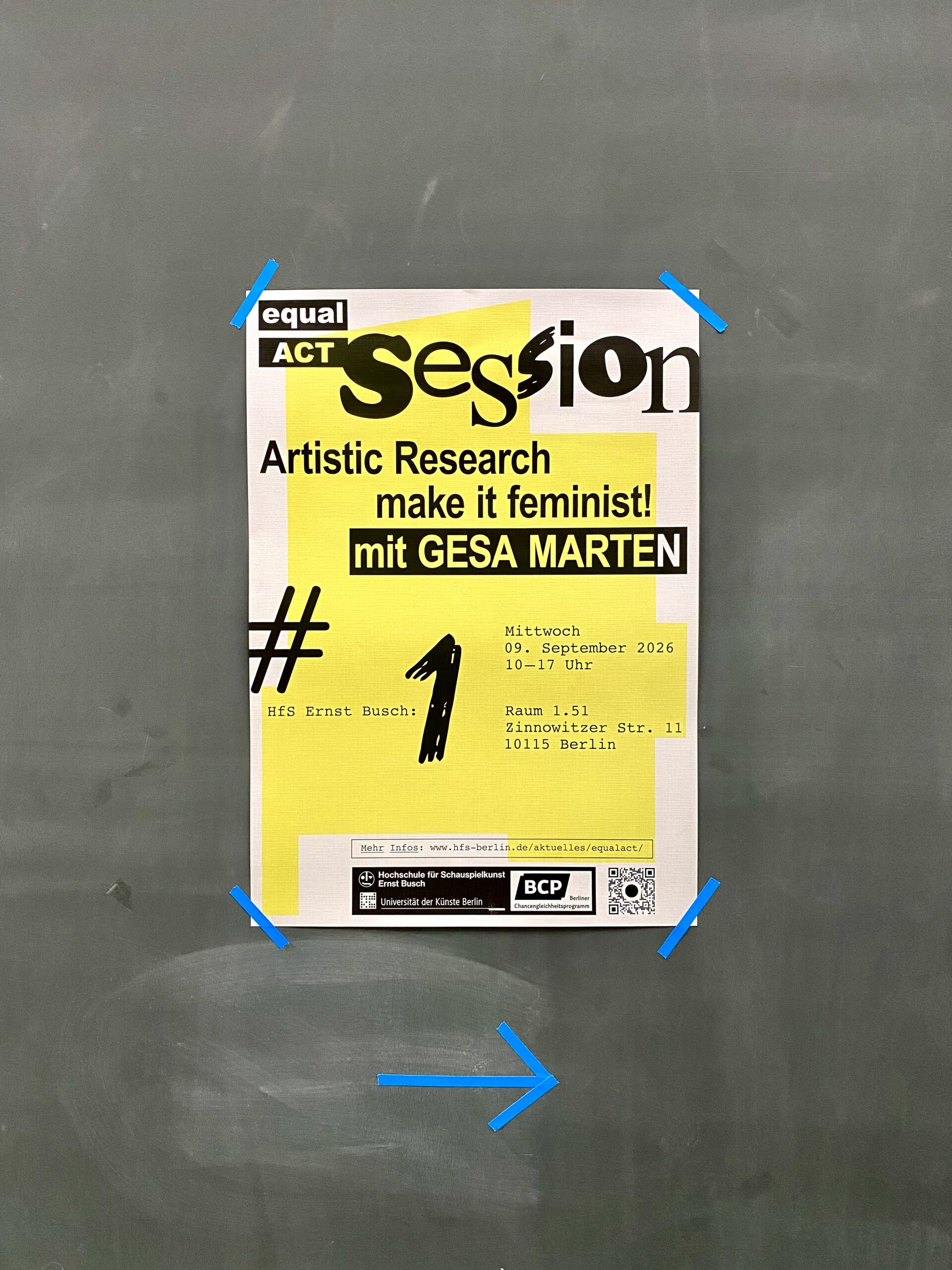
Veranstaltungsplakat der equal ACT Session „Artistic Research – make it feminist!“ mit Gesa Marten am 9. September 2026 an der Hochschule für Schauspielkunst Ernst Busch in Berlin. Das gelbe Plakat ist an einer Tafel befestigt; ein blauer Pfeil weist nach rechts.

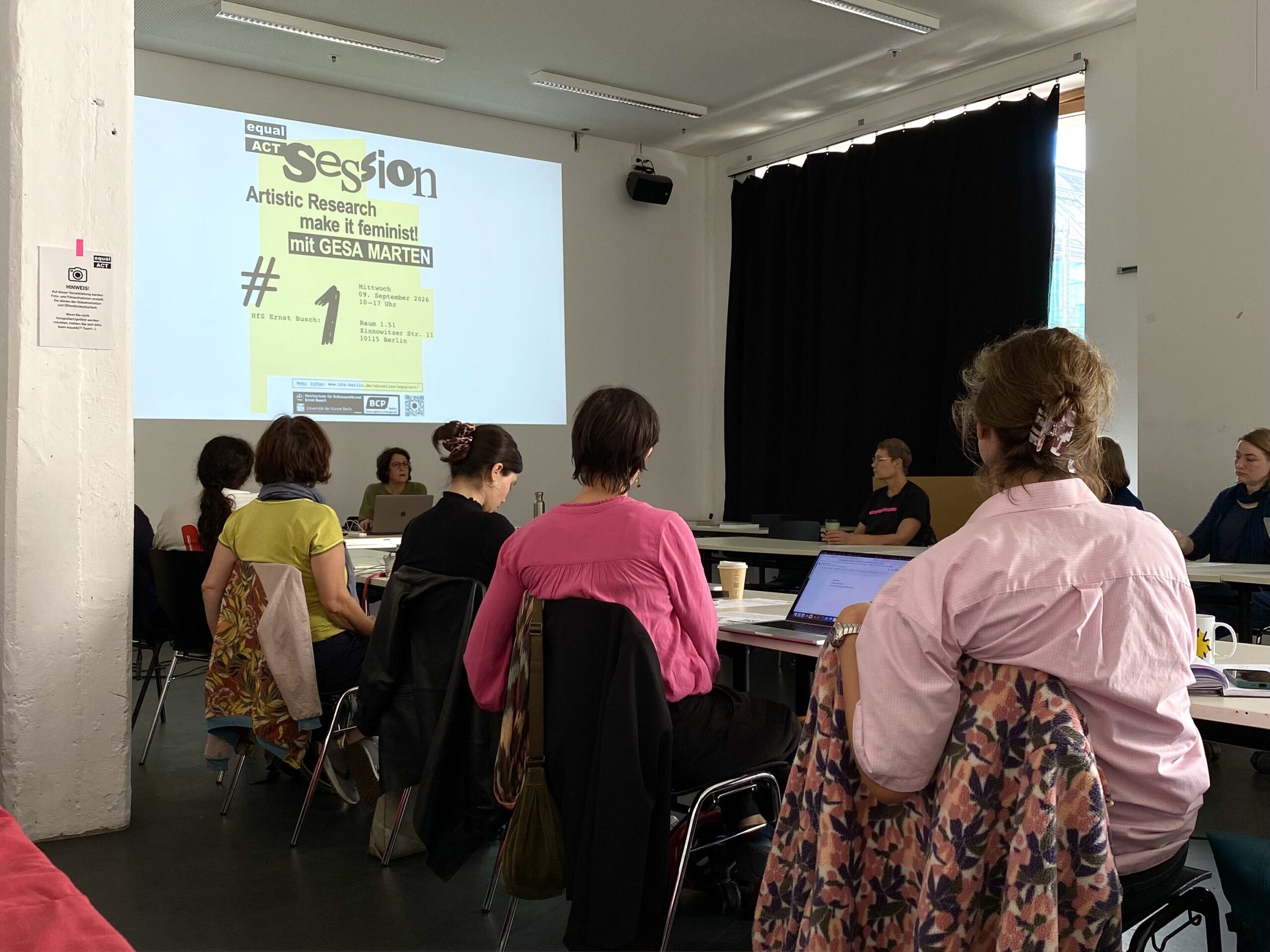
Teilnehmende einer Artistic-Research-Veranstaltung sitzen in einem Seminarraum der Hochschule für Schauspielkunst Ernst Busch. An der Wand ist das Plakat „Artistic Research – make it feminist!“ mit Gesa Marten projiziert. Die Teilnehmenden arbeiten an Tischen mit Laptops und Unterlagen.

Art is not merely the subject of research. Artistic practice can itself generate knowledge.

But what kind of knowledge are we talking about? Who is recognized as a knowing and researching subject? Which experiences, bodies, materials, and relationships become part of a research process? What power lies in our images, archives, technologies, and institutions? What do the methods we use to conduct research themselves produce? And what changes when we not only conduct feminist research but also critically examine research from a feminist perspective?

With equalACT, the Ernst Busch University of Theatre Arts Berlin and the Berlin University of the Arts are launching a joint experiment: Over the course of eight sessions and six labs, equalACT brings together FLINTA* artists, researchers, faculty, and students, as well as diverse knowledge practices from the universities. Six teams are working on artistic research projects involving film, archives, bodies, voices, puppets, technology, and gaming.

In early 2026, the women’s and gender equality officers at the HfS Ernst Busch and the UdK Berlin launched equalACT. The impetus was as practical as it was political: At both universities, there are artists, faculty, and researchers who have been working for years on feminist, queer, intersectional, and anti-discrimination issues – often within their own disciplines, classes, workshops, and projects. Joint initiatives such as Prof*me or #wessenfreiheit demonstrate just how much power is generated when we pool our existing expertise, experiences, and resources. This is precisely why equalACT creates a cross-university and interdisciplinary structure.

At the kick-off in May, FLINTA* individuals from teaching and research at both art universities met, developed shared ideas, and formed new collaborations. In early July 2026, the equalACT team – Susanne Foidl (FGB at the HfS), Vanessa Wozny (FGB at the UdK), Lorena Boße (Project Communication & Coordination), and the project advisory board – comprising Charlotte Freundel, Dr. Jenny Fuhr, Dr. Anna Luise Kiss, and Anne Renner – selected six artistic research projects with a feminist focus for funding.


Six Labs – Six Starting Points

COMPLICATING THINGS – Prof. Hannah Perner-Wilson
Gaming, Technology, Feminism, and Power Structures.

Female Pages – Dr. Vanessa Gravenor, Prof. Mathilde ter Heijne, Prof. Hannah Perner-Wilson, Johanna Stapelfeldt, Prof. Susanne Vincenz
Feminist archival work and non-linear artistic biographies of FLINTA* individuals.

Reframing NEUE BILDER: Schwarzer Filmschaffender in Deutschland – Prof. Dr. Karina Griffith, Benita Bailey
Hyper(in)visibility Schwarzer Filmemacher*innen im deutschen Kino

Frauenblock Berlin: Wie schreiben sich emanzipatorische Räume in Körper, Bewegung und Licht ein? – Sabrina Labis, Isabel Robson

Warum schreie ich nicht, obwohl ich schreie? – Magda Lena Schlott, Ada Biljan
On the Relationship Between Body, Voice, and Puppet.

Wort*e von Frauen – Prof. Ulrike Völger, Ada Biljan
Cataloging, Digitization, and Contextualization of (Spoken) Texts Beyond a Male-Dominated Canon.


Research Needs Connections

Alongside the six labs, eight sessions will take place, creating a shared space for thought and collaboration: Grant recipients will network with guests from the fields of artistic research, various artistic disciplines, and feminist theory and practice. The focus is on research questions and methods, on positioning and responsibility, on archives and the canon, on networks and research ecosystems, on AI and technical systems—and, time and again, on the question: What does artistic practice make tangible, visible, or conceivable that might otherwise remain inaccessible?

Gesa Marten, film editor, dramaturg, and professor at the Film University Babelsberg, kicked off the first session on September 9. In her presentation, she spoke about approaches, methods, and current discourses in artistic research. Gesa Marten has been engaged in artistic research in film for many years and views editing itself as a process of thought and research.

The subsequent colloquium focused on the six funded equalACT projects. The teams presented their projects and initial progress: They shared questions and reflections on their respective approaches and, through joint discussion, developed initial perspectives for their future work. What questions are on their minds, and what remains open at this early stage?

What stood out was the deep mutual interest among the participants. People with very different artistic and professional backgrounds came together for an entire day, listened to one another, asked questions, contributed their thoughts, and shared their experiences. The discussions did not end with the colloquium but continued during breaks and over meals together. It became clear just how important it is to create such a space. By “space,” we do not mean only the physical space with tables and chairs. “Space” also encompasses time, attention, relationships, institutional conditions, and informal conversations.

The event continues on September 29! equalACT is organizing the second session in collaboration with the Research Ecologies team at the BAS (UdK Berlin). The session will focus on the question: What does artistic research need in order to develop—and what role do the spaces, relationships, and structures we create for this purpose play? Together with Dr. Lisa Glauer and Dr. Anne Kurr, we’ll explore research contexts that extend beyond individual projects: How do networks and forms of exchange emerge in which unfinished work can be shared, further developed, and set in motion through other perspectives? In the afternoon, this question will be explored through specific examples of artistic research. Ivana Papić, Nilra Zoraloglu, and Sonya Schönberger will provide insights into their projects and discuss their experiences, methods, and the conditions of their work.

On October 28, under the title *The Lore, Vore, and Core of AI Imagery*, Ava Leandra Kleber and Elisa Deutloff will share their feminist artistic work with and on AI systems. How do these systems transform images and ideas—and what questions arise when their very logics become the subject of artistic research?

At equalACT, we ask what role one’s own position plays in the research process—and what it means for artistic research when archives are not understood as neutral repositories of knowledge. It’s about recognizing that a medium doesn’t just show something but produces meaning itself, that relationships, bodies, affects, and materials are involved in the creation of knowledge, and that not knowing isn’t viewed exclusively as a deficit—for us, this is precisely what “make it feminist” means in artistic research. The slogan is thus also a call to set one’s own practices in motion.


SESSION DATES

September 9, 2026 / Session 1
Artistic Research – Approaches, Examples, and Project Colloquium
with GESA MARTEN (Location: HfS 1.51)

September 29,  2026 / Session 2
Research Ecologies 2026 – Project Insights / Colloquium as a Curated Ecology of Togetherness
with DR. LISA GLAUER, DR. ANNE KURR, and the Berlin Centre for Advanced Studies in Arts and Sciences (BAS)

Oktober 28, 2026 / Session 3
The Lore, Vore and Core of AI-Imagery – Artistic Research on and with AI Systems
with AVA LEANDRA KLEBER and ELISA DEUTLOFF

TBA

December 3, 2026 / Session 4
January 20, 2027 / Session 5
March 3, 2027 / Session 6
April 14, 2027 / Session 7
June 9, 2027 / Session 8
End of 2027 (TBA) / Symposium

The sessions will take place from 10 a.m. to 5 p.m. at the bat Studiotheater (Belforter Str. 15, 10405 Berlin) at the HfS Ernst Busch. Register at equalact@hfs-berlin.de.

More dates and information at www.hfs-berlin.de/aktuelles/equalact/.


A joint project of the Ernst Busch Academy of Dramatic Arts and the Berlin University of the Arts, funded by the Berlin Equal Opportunity Program.


Leave a Reply

Your email address will not be published. Required fields are marked *

Ableism is the discrimination of and social prejudice against people with differing physical and mental abilities and needs. It typically involves a negative assessment of a person’s body and mind due to skills and abilities, based on a supposed biological (physical and/or mental) norm of what an able-bodied, neurotypical person should be. Ableism can intersect with other forms of oppression such as racism and sexism. 

Adultism is the discrimination found in everyday life and law based on unequal power relationships between adults, on the one hand, and children, adolescents, and young people on the other. 

The General Equal Treatment Act (AGG), enforced since 2006, is the uniform central body of regulations in Germany for the implementation of four European anti-discrimination directives. For the first time, a law was created in Germany that comprehensively regulates protection against discrimination on the grounds of race, ethnicity, gender identification, religion or belief, ability, age, or sexual orientation.

Antisemitism is a belief system based on hatred/hostility towards or discrimination against Jewish people as a religious or racial group, Jewish institutions or anyone/anything that is perceived Jewish. Antisemitism varies over time and between cultures, with antisemitism intensifying in different historical moments.   

Xenophobia names the hostility towards groups or individuals perceived as “outsiders” based on their culture. Xenophobic attitudes are often associated with hostile reception of immigrants or refugees who arrive in societies and communities that are not their homelands. Xenophobic discrimination can result in barriers to equally access socioeconomic opportunities, as well as ethnic, racial, or religious prejudice.

Accessibility names the extent to which a product, service, or environment can be used and accessed by as many people as possible. Inclusive accessibility therefore assesses the needs and desires of all possible people—including those who are neurodivergent or who have varying abilities—and incorporates these into its design and function. Changes to enable those with different abilities to have equal opportunity and participation are often referred to as accommodations.  

Harassment is undesired and non-consensual conduct that violates the dignity of another person. Harassment can often create intimidating, hostile, humiliating, or offensive environments, and can be based on someone’s sexual orientation, religion, national origin, disability, age, race, gender, and more. Harassment can take a variety of forms, including verbal, physical, and/or sexual. 

The gender binary is the classification of gender into two distinct and opposite categories of man/masculine and woman/feminine. This belief system assumes that one’s sex or gender assigned at birth will align with traditional social constructions of masculine and feminine identity, expression, and sexuality. Assignment beyond the gender binary is typically viewed as a deviation of the norm. 

Sex refers to a person’s biological status and is typically assigned at birth, usually based on external anatomy. Sex is typically categorized as male, female, or intersex. 

Cisgender, or simply cis, refers to people who identify with the gender assigned to them at birth. Cis comes from the Latin prefix which means “on this side of.” 

This concept, according to Birgit Rommelspacher, assumes that there is a system of hierarchies, rule and power in which the various racist, sexist, classist, and other forms of governance intertwine. In this interconnectedness, a dominant group maintains power, which is socially negotiated again and again. In a given society, the dominant group achieves their role by being perceived as pertaining to a majority of the population and having a significant presence in societal institutions. 

The prison-industrial complex (PIC) is a term that describes the complex and interrelated dependencies between a government and the various businesses and institutions that benefit from practices of incarceration (such as prisons, jails, detention facilities, and psychiatric hospitals). Based on the term “military-industrial complex,” PIC urges a more comprehensive analysis of how imprisonment is used in a society, noting all the interest groups that prioritize financial gain over keeping people out of prisons. 

Gender-expansive is an adjective that can describe someone with a more flexible and fluid gender identity than might be associated with the typical gender binary. 

Gender is often defined as a social construct of norms, behaviors, and roles that vary between societies and over time. Gender is often categorized as male, female, or nonbinary. 

Gender transition is a process a person might take to bring themselves and/or their bodies into alignment with their gender identity. This process is not a singular step nor does it have a definite end. Rather, it can include any, none, or all of the following: telling one’s family and social circles; changing one’s name and pronouns; updating legal documents; medical interventions such as hormone therapy; or surgical intervention, often called gender confirmation surgery. 

Gender expression is how a person presents gender outwardly, most typically signalled through clothing, voice, behavior, and other perceived characteristics. Society identifies these cues and performances as masculine or feminine, although what is considered masculine or feminine varies over time and between cultures.  

Gender dysphoria refers to psychological distress that results from the incongruence between one’s sex assigned at birth and one’s gender identity. People of all genders may experience dysphoria at varying levels of intensity, or not at all. 

Gender identity is one’s own internal sense of self and their gender. Unlike gender expression, gender identity is not externally visible to others. 

Heteronormativity is the concept that heterosexuality—romantic and/or sexual attraction between people of the “opposite” gender—is the normative or acceptable sexual orientation in a society. Heteronormativity assumes the gender binary, and therefore involves a belief in the alignment between sexuality, gender identity, gender roles, and biological sex. As a dominant social norm, heteronormativity results in discrimination and oppression against those who do not identify as heterosexual.   

Hormone therapy, sometimes called gender-affirming hormone therapy (GAHT) or hormone replacement therapy (HRT), is the process by which sex hormones or other hormonal medications are administered. These hormone changes can trigger physical changes, called secondary sex characteristics, that can help better align the body with a person’s gender identity.

Institutional discrimination refers to prejudiced organizational policies and practices within institutions – such as universities, workplaces, and more – such that an individual or groups of individuals who are marginalized are unequally considered and have unequal rights. 

Inter*, or intersex, is an umbrella term that can describe people who have differences in reproductive anatomy, chromosomes, or hormones that do not fit typical definitions of male and female. The asterisks (*) emphasizes the plurality of intersex realities and physicalities. 

Intergenerational trauma refers to the trauma that is passed from a trauma survivor to their descendent. Due to violent and terrifying events—such as war, ethnic cleansing, political conflict, environmental catastrophe, and more—experienced by previous generations, descendants may experience adverse emotional, physical, and psychological effects. As the original sources of trauma are structured by forms of discrimination such as race and gender, intergenerational trauma also occurs along intersectional axes of oppression. For example, Black communities have brought to light the intergenerational trauma of enslavement. 
Intergenerational trauma is sometimes called historical trauma, multi- or transgenerational trauma, or secondary traumatization. 

Intersectionality names the interconnected nature of systems of oppression and social categorizations such as race, gender, sexuality, religion, migratory biography, class and more. Intersectionality emphasizes how individual forms of discrimination do not exist independently of each other, nor can they be considered and addressed independently. Rather, addressing oppression should take into account the cumulative and interconnected axes of multiple forms of discrimination. 

Islamophobia is a belief system based on hatred/hostility towards or discrimination against Muslim people as a religious or racial group, muslim institutions or anyone/anything that is perceived Muslim. Islamophobia varies over time and between cultures, with Islamophobia intensifying in different historical moments.

Classism is a term that describes discrimination based on the belief that a person’s social or economic status determines their value in society. Classism, as a form of discrimination and stigmatization, is based on actual or assumed financial means, educational status, and social inclusion. “Inferior” classes in the hierarchy are problematised and stereotyped, and often receive unequal access and rights within society. 

Colonialism is the control and dominance of one power over a dependent area or people. In subjugating another people and land, colonialism entails violently conquering the population, often including mass displacement of people and the systematic exploitation of resources. Beyond material consequences, colonialism also includes processes of forcing the dominant power’s language and cultural values upon the subjugated people, thereby effecting cultural, psychological, and intergenerational trauma. 

Culturally argued racism is directed against people based on their presumed cultural or religious background. This form of discrimination can occur regardless of whether they actually practice one culture or religion and how religious they are (e.g. anti-Muslim racism and anti-Semitism). 

Cultural appropriation is the act of taking on aspects of a marginalized culture by a person or an institution who is outside of that culture, without comprehensive understanding of the context and often lacking respect for the significance of the original. Cultural appropriation, when promoting negative cultural or racial stereotypes, reproduces harm. Acts of cultural appropriation can often reveal power dynamics within a society: for example, a white person who wears a marginalized culture’s traditional dress is praised as fashionable, while a racialized person could be isolated from the dominant group and marked as foreign.  

Marginalization describes any process of displacing minorities to the social fringe. As a rule, marginalised groups are presumed to not correspond to the norm-oriented majority of society and are severely restricted in their ability to behave freely, have equal material access, enjoy public safety, and more.  

Microaggression names individual comments or actions that unconsciously or consciously demonstrate prejudice and enact discrimination against members of marginalized groups. As small, common, and cumulative occurrences, microaggressions can comprise of insults, stereotypes, devaluation, and/or exclusion. Microaggressions often negatively affect the person on the receiving end, affecting their psychological and physical health and wellbeing. 

Misogyny is a term for sexist oppression and contempt for women that is used to keep women at a lower social status than men, thereby maintaining patriarchal social roles. Misogyny can indicate an attitude held by individuals and a widespread cultural system that often devalues anything perceived as feminine. Misogyny can overlap with other instances of oppression and hate—such as homophobia, trans*-misogyny, and racism. 

Neurodiversity is a term that describes the unique ways each person’s brain structures function. The basic assumption of what kind of brain functioning is healthy and acceptable within a norm-oriented majority society is called neurotypical. 

Nonbinary is a term that can be used by persons who do not describe themselves or their genders as fitting into the binary categories of man or woman. A range of terms are used for these experiences, with nonbinary and genderqueer often used. 

Patriarchy is a social system whereby cis men dominantly hold positions of privilege both in public and private spheres. In feminist theory, patriarchy can be used to describe the power relationship between genders that favors male dominance, as well as the ideology of male superiority that justifies and enacts oppression against women and all non-normative genders. 

Pronouns, or personal gender pronouns (PGPs), are the set of pronouns that an individual uses to refer to themselves and desires for others to use when referring to them. The list of pronouns is continuously evolving. An individual may have several sets of preferred pronouns, or none. The intention of both asking and using a person’s pronouns correctly is to reduce the negative societal effects for those whose personal pronouns don’t match with the gender identity that’s assumed by a cisnormative society. Using gender-neutral wording and terms to refer to groups of people (such as “folks,” instead of “guys”) are also inclusive steps that resist the gender binary and cis-normativity. 

Racism is the process by which systems, policies, actions, and attitudes create unequal opportunities and outcomes for people based on race. More than individual or institutional prejudice, racism occurs when this discrimination is accompanied by the power to limit or oppress the rights of people and/or groups. Racism varies over time and between cultures, with racism towards different groups intensifying in different historical moments.   

Sex-gender difference names the distinction between the concept of “sex” as a biological fact and the concept of “gender” as a product of cultural and social processes, such as socially constructed roles, behaviours, expressions and gendered identities.

Sexism is the process by which systems, policies, actions, and attitudes create unequal opportunities and outcomes for people based on their attributed or supposed sex and the ideology underlying these phenomena. It is mostly used to name the power relations between dominant and marginalised genders within cisheteronormative patriarchal societies.

Sexual orientation is the term that describes which sex or gender a person feels emotionally, physically, romantically and/or sexually attracted to.

Social origin describes the socio-cultural values and norms into which one is born, including factors such as environment, class, caste, education biography, and more. The values that accompany one’s social origin are constructed, but often have material impact that privileges or under-privileges certain groups and people. For example, someone whose social origin includes living in a Western country, inheriting intergenerational wealth, and having a consistently good education will increase their chances for a high-paying job as an adult. Their social origin must therefore be taken into account, rather than their inherent worthiness for such a job. 

A social norm is a shared belief in the standard of acceptable behaviour by groups, both informal as well as institutionalized into policy or law. Social norms differ over time and between cultures and societies. 

Socioeconomic status, usually described as low, medium, or high, is a way of describing people based on their education, income, and type of job. The values and norms assigned to each socioeconomic class are socially constructed but have material impact. 

Structural discrimination refers to patterns of behaviour, policies, and attitudes found at the macro-level conditions of society. This discrimination of social groups is based on the nature of the structure of society as a whole. Structural discrimination is distinct from individual forms of discrimination (such as a single racist remark, which is a microaggression), though it often provides the contextual framework to understand why these individual instances occur. 

Xenophobia names the hostility towards groups or individuals perceived as “outsiders” based on their culture. Xenophobic attitudes are often associated with hostile reception of immigrants or refugees who arrive in societies and communities that are not their homelands. Xenophobic discrimination can result in barriers to equally access socioeconomic opportunities, as well as ethnic, racial, or religious prejudice.

Tokenism is a superficial or symbolic gesture that includes minority members without significantly changing or addressing the structural discrimination of marginalization. Tokenism is a strategy intended to create the appearance of inclusion and to divert allegations of discrimination by requiring a single person to be representative of a minority. 

White supremacy names the beliefs and practices that privilege white people as an inherently superior race, built on the exclusion and detriment of other racial and ethnic groups. It can refer to the interconnected social, economic, and political systems that enable white people to enjoy structural advantages over other racial groups both on a collective and individual level. It can also refer to the underlying political ideology that imposes and maintains multiple forms of domination by white people and non-white supporters, from justifying European colonialism to present-day neo-fascisms. 

Whiteness is a socially and politically constructed behaviour that perpetuates an ideology, culture, history, and economy that results in the unequal distribution of power and privilege favoring those socially deemed white. The material benefits of whiteness are gained at the expense of Black, Indigenous, and people of color, who are systematically denied equal access to those material benefits. 
On our blog, white is often written in small italics to mark it as a political category and emphasize the privileges of whiteness which are often not named as such, but rather taken for granted as the invisible norm. 

Xenophobia names the hostility towards groups or individuals perceived as “outsiders” based on their culture. Xenophobic attitudes are often associated with hostile reception of immigrants or refugees who arrive in societies and communities that are not their homelands. Xenophobic discrimination can result in barriers to equally access socioeconomic opportunities, as well as ethnic, racial, or religious prejudice.

Abolition is a term that names officially ending a system, practice, or institution. Rooted in 19th century movements to abolish slavery, present day abolitionism is often invoked to end the practice of policing and military and/or the interconnected carceral systems of prisons, refugee camps, detention centers, and more. For more, see the definition of prison-industrial complex). 

Accountability is the obligation and willingness to accept responsibility for one’s actions. In the context of social justice, accountability refers to the ways in which individuals and communities hold themselves to their principles and goals, as well as acknowledging the groups to which they are responsible. Accountability often requires a transparent process and continuous self- and collective awareness. 

Ageism is discrimination or prejudice based on a person’s age, such as when skills and abilities are questioned and assessed based on one’s older or younger age. 

Agender is an adjective that can be used by persons who do not identify as any gender.

BIPoC stands for Black, Indigenous and people of color. A term that originated in the U.S., it is a self-designation intended to center the specific experiences of Black, Indigenous, and other racialized groups, who are severely impacted by systemic racial injustice rooted in histories of enslavement and colonialism, and to unite people and groups affected by racism. 

Colorism is a term that describes the prejudice or discrimination favoring people with lighter skin tones over those with darker skin tones. This is especially used to describe the nuanced discrimination faced within a racial or ethnic group. 

The Critical Diversity Policy at UdK is a document whose intention is to emphasize and enforce the idea that differences in values, attitudes, cultural perspective, beliefs, ethnic backgrounds, sexual orientation, gender identity, abilities, knowledge and life experiences of each individual in each group of people should be considered and overcome within the university.

Deadnaming is the act of calling a trans*, nonbinary, or gender-expansive person by their birth name, or an incorrect name, when they have changed their name as part of their gender expression. It is never okay or necessary to use a person’s deadname when they have changed their name, including when describing past events. If you deadname someone, take accountability by apologizing and commit to not doing so in the future. Take steps to know someone’s current name and commit to using it.   

This sociological term focuses on how people observe, (re-)produce, and make gender relevant in everyday life. Rather than taking gender as an innate quality, the acts of “doing gender” emphasize how gender is a social construct that is prevalent in daily human interaction. 

Misogynoir is a term, coined by Black feminist Moya Bailey in 2010, that describes the gendered and racial oppression faced by Black cis and transgender women (the latter sometimes referred to as trans*-misogynoir). Taking an intersectional lens, misogynoir examines how anti-Black racism and misogyny combine into a particular form of oppression and discrimination. 

Queer is an umbrella term for people who are not heterosexual or cisgender. It Is used for a broad spectrum of non-normative sexual and/or gender identities and politics. 

Safer spaces are intended to be places where marginalized communities can gather and communicate shared experiences, free of bias, conflict, or harm perpetrated by members of a dominant group. Recognizing that there is no such thing as a perfectly safe space for marginalized people under the current systems of our society, the term “safer” indicates the goal of temporary relief, as well as acknowledging the fact that harm can be reproduced even within marginalized communities. 
Examples of safer spaces created in organizations and institutions are queer-only spaces and/or spaces only for Black, Indigenous, and people of color. 

Social justice is a form of activism and political movement that promotes the process of transforming society from an injust and unequal state to one that is just and equitable. Social justice is rooted in the view that everyone deserves equal economic, political, and social rights and opportunities, and the fundamental right to feel psychologically and physically secure. Social justice therefore aims to change governing laws and societal norms that have historically and presently oppressed some groups over others. Social justice is not just the absence of discrimination, but also the presence of deliberate systems and supports that achieve and sustain equity along lines of race, gender, class, ability, religion, and more. 

Transgender, or simply trans*, is an adjective that refers to people whose gender identity is different than the sex assigned at birth. Trans comes from the Latin prefix which means “across” or “beyond.” The self-designation is not an identity feature that automatically indicates whether this person identifies with a different gender, no gender or multiple genders. Thus, there are several trans* identities. The asterisks (*) emphasizes the plurality and fluidity of trans identities.